
Guest blog: Hidden Labour and Workers Forums Data Do Matter!
Media
Image
Blog content
What is the ‘hidden’ labour of platform workers, how can we learn about it, and why is it important? In this guest blog, Dr Wifak Gueddana reflects on these questions and introduces her pioneering research project.
Platforms have been a key subject of publications over the past decades with a few unicorns that have been particularly under the spotlight such as, Uber, Deliveroo, Amazon and AirBnB. When first introduced, they have been heralded as ‘new’ technology disruptors that have transformed labour markets by eliminating intermediaries, connecting workers with clients and lowering barriers to access jobs.
This so-called ‘platformisation’ of work has been a crucial dimension in the rise of platforms and the gig economy more generally. It has also been a productive paradigm from a research point of view that led many to conceptualise platforms as just apps or, bounded tech spaces with distinctive relationships of control and trust. A majority of publications have thus presented platforms in isolation from key social and political relations – i.e. notably non-standard work arrangements and cross-sector evolution – that are yet crucial aspects in understanding changes in the world of work more broadly.
By adopting a tech-logic that defines one platform simply as a mode of digital affordance – be it bad or good for users – it has become possible to treat it separately from traditional studies on labour and employment and to create a disconnect with traditional sociology of work and industrial relations. Not only existing employment studies struggle to identify the broader implications of platform takeover on workers’ lives and livelihood in and across sectors. But, both motives and drivers of workers’ adoption of one app, be it Uber, Lyft or Hail, are seldom studied in relation to other apps, or contextualised in relation to users’ working practices outside the app. Therefore, if we are today to further our understanding of platform work in order to ensure agile and representative regulatory frameworks, an effective and powerful workers’ organising, and good online labour markets for the consumers (workers), it is crucial to design broader inquiries that resist platform-centrism and go against this paradigm of the so-called ‘platformisation’ of work.
To do that, we must first recognise that platform-working extends well beyond the digital boundaries of Uber, Deliveroo and AirBnB, as well as has deep connections with online communities, and the rise of digital media more generally. Second, we must create and access alternative sources of data that capture workers’ voices, while at the same time are not dependent on platforms’ transactional view of work (logs of transactions), or seek to further the existing information asymmetry between workers and platform owners. More importantly, we need to design methods that are politically productive, so that workers’ inquiries can be participatory tools, while they are also rooted in large-scale analysis of platform workers’ data in and across sectors.
Based on the above, we have developed a research strategy that purposefully approaches platforms as an auxiliary concept, while at the same time it stays focused on workers who use apps and websites to carry out work online and in local markets. To start, we sought to identify multiple and not-necessarily-platform-specific online spaces of digital labour that are typically used to carry out work online and also to support platform work on apps – instead of purposefully selecting one or a few platforms.
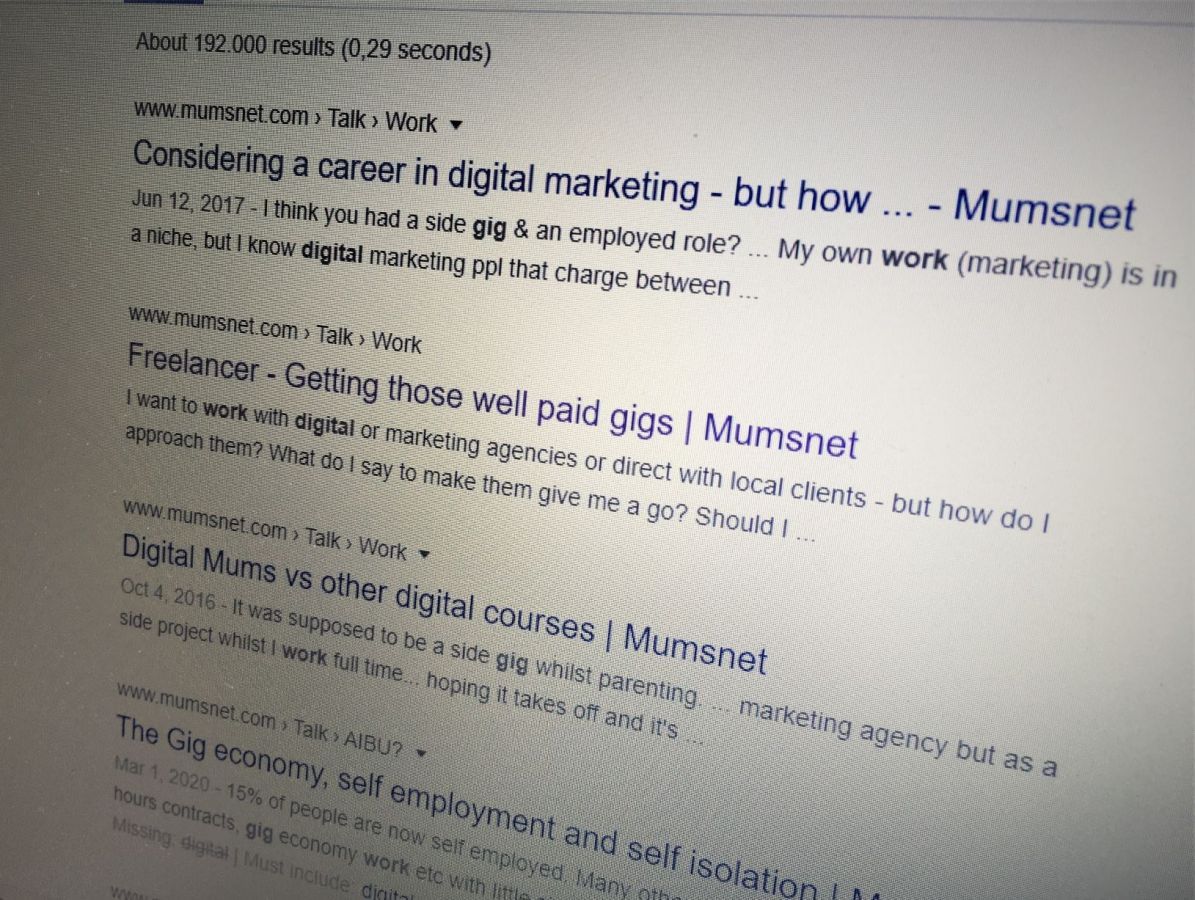
These spaces are online communities of work on sites such as Reddit, Mumsnet, UKBusinessForum, MoneysavingExpert.com; among these are also group chats on Facebook, WhatsApp, etc., private platform forums such as Uber Forums, Amazon Forum and PPH forum, as well as other social media pages, which can encapsulate new bodies of knowledge on platform-working, the changing nature of work and the life of platform-workers. Such data are routinely produced and in real-time, presented as posts, memes and thread-discussions that can allow us to develop rich and qualitative evidence on platforms’ algorithmic exploitation, automated inequality, workers’ wellbeing and care as well as new forms of online organising and individual and collective resilience.
Our objective is to use these sites as an alternative data source and create new streams of evidence about platform-working: of people asking questions, checking information, arguing, campaigning, talking about what they are doing, and offering what they think. We also seek to draw communalities and differences between discussions, groups, communities and their perceptions of working for multiple platforms, hopping between apps and juggling between jobs, tasks and clients. This could then help to characterise key working practices of platform workers, their working conditions and to understand the implications of these on their lives.
The rationale behind looking into work forums and platform-related threads and discussions is the following: platform work goes beyond paid tasks on apps. In fact, workers often invest in multiple practices outside the physical boundaries of apps and platform websites that still constitute a major part of their work. This is referred to as digital labour and includes all sorts of support activities such as searching online, interacting with others, acquiring skills, sharing experience, building a reputation, reviewing clients, monitoring payments and asking for tech and peer-support.
For example, in the case of clickwork, initial research shows that platform workers can carry out large chunks of unpaid work in proportion to paid labour. Clickworkers who use websites such as Amazon MKT, CrowdFlower, Swagbucks, CloudFactory, etc. could spend as much as 20 mins that are not paid (FT 2018). This includes search, taking unpaid qualification tests, profiling clients to mitigate fraud and writing reviews. When added up, the total time spent to deliver tasks could earn them less than the minimum wage in countries such US, UK and Germany (Ibid).
This said, digital labour is also not limited to clickwork. Many online freelancers – i.e. software programmers, creatives, writers, content editors, graphic designers, and video editors – invest digital labour at varying degrees to deliver jobs for outsourcing companies. This is also uncharacterised and unpaid. For example, users of sites such as Upwork, Toptal, Fiverr, etc. invest time and money in continuously developing new language skills, tools, etc.; it is also important for them that while working, they keep searching for jobs and try to maintain regular income. On top of that they have to develop new skills in self-branding and advertising across work forums and platforms to increase visibility and build reputation. For Amazon vendors, digital labour is also essential and forums are great help for vendors. They use them to manage their accounts and understand the logic and management of search optimisation, which is a key feature of their Amazon business. In this sense for them too, the time invested to deliver online orders is unknown and part of it will remain forever unpaid.
Digital labour is also not limited to working online. App drivers (Uber, Lyft, etc.) and platform-independent couriers also spend unmeasured time and money to apply for licenses, clean cars, carry out MOT checks, etc. They must pay to hire cars, or apply for bank loans. Many subscribe to WhatsApp, FB and other drivers’ forums to share experience, traffic information and build support groups. They seek accurate and timely information that can help them know, for example, where other drivers are meeting, which roads are obstructed that do not show-up on the Uber map; they can know that for some drivers especially in London, these maps are not seen as helpful, so they keep them in the background while using Whaze or the iPhone map.
The point here is that the nature and extent of this digital labour is hardly studied and characterised. It is hidden and deemed unproductive. As support work that allows a worker to avoid scams, find a job and get paid, it is somewhat assumed that she should be the only one responsible to make it pay-off. This is part of workers’ digital livelihood in which the amplified risks of working with apps and websites has to be taken-on by individuals without the support of the clients’ organisations. Digital labour thus describes platform users’ working conditions, i.e. all what they do to generate income in sometimes invisible, opaque, isolating and alienating conditions. This leads us to reflect possibly on several issues, including pay and platform payments in relation to real working hours, and how can working in these conditions not create new forms of work intensification and longer hours that workers will always not get paid for.
On another note, forum data and discussion threads should also be studied for their own intrinsic value; they are not only material representations of digital labour; but they also represent the digital footprints of workers and a counter-weight to the information asymmetry created by apps and platform websites. Indeed, it is well-known that platforms such as Uber, Deliveroo, AirBnB and Amazon can monetise extensive records of workers’ data and logs of transactions that are produced on their servers and by doing so, they can control incumbents and future service markets. However, researchers and third parties are increasingly paying them to partially access these datasets. In doing so, they support this power asymmetry and give added value to platform data such as transaction logs -although these have been algorithmically produced and cannot extend beyond the app.
Accordingly, platforms’ logs of transactions (=worker’s time*hourly rate) start to supersede other traditional measurements, such as workers’ income, while they are not necessarily the appropriate proxy for that. The reasons for that are manifold. First, workers could use apps interchangeably, hence could get paid from multiple apps and clients at the same time. So, while a worker could have composite income, she continues to be perceived as ‘dependent’ on one or a few unicorns. It could also be the opposite, in that a worker’s earnings are less than the sum of payments in one or more apps. For example, workers can themselves outsource paid tasks to friends and family, hence generate less money individually. They can also earn less because as we have mentioned above, their total working time (inside and outside apps) has not been measured and factored in the net income.
For all these reasons, transaction logs are not good estimates of platform work including workers’ digital labour. More importantly, they can be dangerous if relied on for policy making because they hide workers’ voices, working conditions and reinforce platforms’ power asymmetry. Therefore, and unless we gain a direct insight into the practices of platform-working from the forum-discussions and the voices of the workers themselves, we may end-up underestimating the nature and scope of platform-work and relying on a platform-centric view that is reductive and unsensitive to the hidden cost of platform-working.
Methodological Challenges
Methodologically speaking, studying gig work forums and social media data can be complex and difficult to research. One of the most important principles of social research is building evidence that is framed by research questions and is also representative of the larger population. Representivity is not always important, of course, but it matters more when a study wishes to draw communalities between groups -rather than differences. In this sense, what common experiences may platform-workers have and how can these characterise their work beyond website affordance?
However, large-scale analysis and representative research on social media are no easy task. New technologies are needed to understand very large, often complex social media datasets that are unfamiliar to social science, and do not easily fit within the conventional methods and frameworks that it uses. This study is thus exploratory and experimental in nature. It has to somewhat represent workers; but more importantly it must identify and map through platform workers’ online networks and study their discussions. To do that, a large and systematic analysis across work forums is required. This also relies on developing the appropriate nexus of partners and technologists (e.g. University of Sussex and CASM Consulting LLP) to build new partnerships and better ways of conducting research on gig work forums and related social media data. For example, we plan now to use a pioneering in-house social media analysis technology – ‘Method52’ – co-developed by the Centre for the Analysis of Social Media CASM with technologists at the University of Sussex, to capture and analyse a range of voices and topics across forums, including:
- themes or key topics that are common across groups and forum communities: e.g. implications of platform work on well-being, care work; common problems with platforms; perceptions of positives and negatives related to gig work and platforms
- the loudest voices, most shared images, biggest stories and most powerful messages dominating the thread discussions
- visualise influential sub-networks, key nodes and link them to key topics
This large-scale computational analysis should allow us to generate key topics and filter through datasets in order to identify relevant networks of workers, as well as the social and political dynamics among them, as well as between them and the platform administrators. Its key output is to create an exploratory space for us to read through relevant key discussions, operate manual codes and identify key users who can be interviewed and invited to participate in complementary focus groups. Topics and network visualisations will also be shared with professional groups and focus group participants to enable a productive discussion on the limits and benefits of this methodology and whether this could be at all used to empower workers and help them organise.
Biography
Wifak Gueddana is a researcher in the department of Digital Humanities at King’s College London. She is currently leading an EPSRC Network+ research project, titled: ‘Platforms, Forums and Hidden Labour: The Invisible, Underpaid and Unregulated World of Domestic and Care Labour’. Her background is in Science and Technology Studies (STS) and Digital Media Studies. Her research focuses on emerging work practices, platform mediation and online communities. She has contributed to the development of mixed computational and qualitative tools and to the use of alternative data sources to study online work and the gig economy.